
Companies spend massive amounts of money on technology every year. Much of this spending goes toward tasks that take too long, systems that don't work well together, and processes that waste resources.
AI helps businesses cut technology costs by automating repetitive work, finding wasteful spending patterns, and making smarter decisions about where to invest their IT budgets.

More than 90% of business leaders believe AI will play a key role in reducing costs over the next 18 months. The technology offers real ways to save money beyond just doing things faster.
AI can spot problems before they become expensive, predict future needs more accurately, and handle complex tasks that used to require large teams. The challenge is turning these benefits into actual savings.
Many companies use AI to boost productivity but struggle to see lower costs on their balance sheets.
Key Takeaways
- AI cuts technology costs by automating tasks, finding waste, and improving how you allocate IT budgets
- Most business leaders expect AI to deliver significant cost reductions within the next year and a half
- Success requires moving beyond productivity gains to achieve real financial savings that show up in your bottom line
Core Principles of AI in Reducing Technology Spend

AI reduces technology costs by automating manual work, optimizing resource use, and eliminating waste before applying advanced solutions. Organizations need to understand what cost reduction through artificial intelligence means, why strategic adoption matters, and how to measure real savings through total cost of ownership.
Defining AI and Cost Reduction
AI uses machine learning and automation to analyze patterns, make decisions, and complete tasks without human help. Cost reduction happens when you lower expenses while maintaining or improving output quality.
When you combine AI with cost reduction, you create systems that identify waste and inefficiencies faster than traditional methods. More than 90% of executives recognize AI's role in reducing costs over the next 18 months.
The key is not just automating existing work. You need to rethink how your processes work from the ground up.
Companies that only use AI to do the same work faster miss opportunities for real savings. Cost reduction through artificial intelligence includes eliminating low-value tasks, speeding up timelines, and improving how employees and customers experience your services.
Strategic Importance of AI Adoption
Your AI adoption strategy determines whether you achieve meaningful returns or waste money on failed projects. Strategic AI deployment supports better decision-making in critical business functions.
You should start by identifying your biggest friction points. Ask why your business needs AI tools instead of deploying them for novelty.
This approach helps you focus resources where they generate the most value.
Strategic AI adoption requires three elements:
- Linking AI tools to specific business problems
- Measuring impact against clear financial targets
- Building skills within your organization to sustain improvements
Companies that apply AI alongside traditional cost measures see bigger benefits than those using either approach alone.
Total Cost of Ownership and Savings Measurement
Total cost of ownership (TCO) includes all expenses for acquiring, deploying, and maintaining AI systems over their lifetime. You must track purchase costs, implementation fees, training expenses, and ongoing maintenance.
Measuring real savings requires tracking:
- Time saved on specific tasks
- Headcount reductions or redeployment
- Process speed improvements
- Error reduction rates
- Budget impact in dollars
You need to set cost reduction targets in your budgets and measure them rigorously. This ensures productivity gains translate into actual bottom-line savings.
TCO calculations help you compare AI investments against current methods. A task that takes 20 hours manually but only minutes with AI shows clear savings when you factor in labor costs and speed to market.
Key Areas Where AI Delivers Cost Savings
AI solutions deliver measurable financial benefits across multiple technology functions by automating manual work, predicting equipment failures before they happen, optimizing computing resources, and handling customer interactions without human intervention.
These four areas represent the biggest opportunities for technology spend reduction.
Automation of Repetitive Tasks
Automation eliminates the need for human workers to handle routine technology tasks that consume significant time and budget. AI assistants can now process data entry, generate reports, manage system updates, and handle file organization without supervision.
Your IT team spends less time on mundane activities when AI handles tasks like user account provisioning, password resets, and software deployment. A biopharma company reduced drafting time by 70% to 90% for product quality reviews by automating data collection and content generation.
Common automation targets include:
- Data backup and recovery procedures
- System monitoring and alert management
- Software patch deployment
- Security log analysis
- Report generation and distribution
The efficiency gains from automation allow you to reassign technical staff to higher-value projects. Your technology budget shrinks as you need fewer people to maintain daily operations.
Predictive Maintenance and Downtime Prevention
Predictive maintenance uses AI to analyze system performance data and identify potential failures before they cause outages. This approach prevents expensive emergency repairs and eliminates revenue loss from unexpected downtime.
AI integration with your monitoring tools creates models that detect unusual patterns in server performance, network traffic, or application behavior. You receive alerts about degrading hardware components days or weeks before they fail completely.
Your maintenance costs drop because you replace components on a planned schedule instead of dealing with emergency situations. You avoid paying premium rates for urgent hardware shipments or after-hours technician fees.
The technology also extends equipment lifespan by catching small problems before they cause cascading damage. Companies using predictive maintenance report 25-30% reductions in maintenance costs compared to traditional reactive approaches.
Your systems stay online longer, which protects revenue and preserves customer trust.
IT Infrastructure and Resource Optimization
AI optimizes how your computing resources are allocated and used across your technology environment. The systems analyze workload patterns and automatically adjust server capacity, storage allocation, and network bandwidth to match actual demand.
AI algorithms help optimize infrastructure costs by identifying underutilized servers, unused software licenses, and redundant storage. You pay only for the capacity you actually need instead of maintaining excess resources “just in case.”
Cloud computing costs decrease when AI right-sizes your virtual machines and shuts down non-essential resources during off-peak hours. Your data center energy bills shrink as AI adjusts cooling systems and power distribution based on real-time heat and load conditions.
Optimization benefits include:
| Resource Type | Typical Savings |
|---|---|
| Cloud computing | 30-40% |
| Software licenses | 20-35% |
| Energy consumption | 15-25% |
| Storage costs | 25-30% |
Customer Support Automation
Virtual assistants and chatbots handle customer technology questions without involving your support staff. These AI solutions resolve common issues like login problems, feature questions, and basic troubleshooting steps instantly.
Your support costs decline as chatbots manage 60-80% of routine inquiries that previously required human agents. The AI assistant works 24/7 without breaks, overtime pay, or benefits expenses.
You maintain smaller support teams while still providing fast response times. Chatbots learn from each interaction and improve their ability to solve problems over time.
They escalate complex issues to human technicians only when necessary, which lets your skilled staff focus on difficult technical challenges. A consumer goods company achieved efficiency gains of approximately 60% in marketing support functions, with some automated tasks reaching 90% efficiency improvements.
Your customer satisfaction often increases because AI provides immediate responses instead of making users wait in queue. Human agents become more productive when they handle only the cases that truly need their expertise.
This cost-cutting approach reduces your per-ticket support expenses while maintaining or improving service quality.
Data-Driven Insights and Spending Optimization
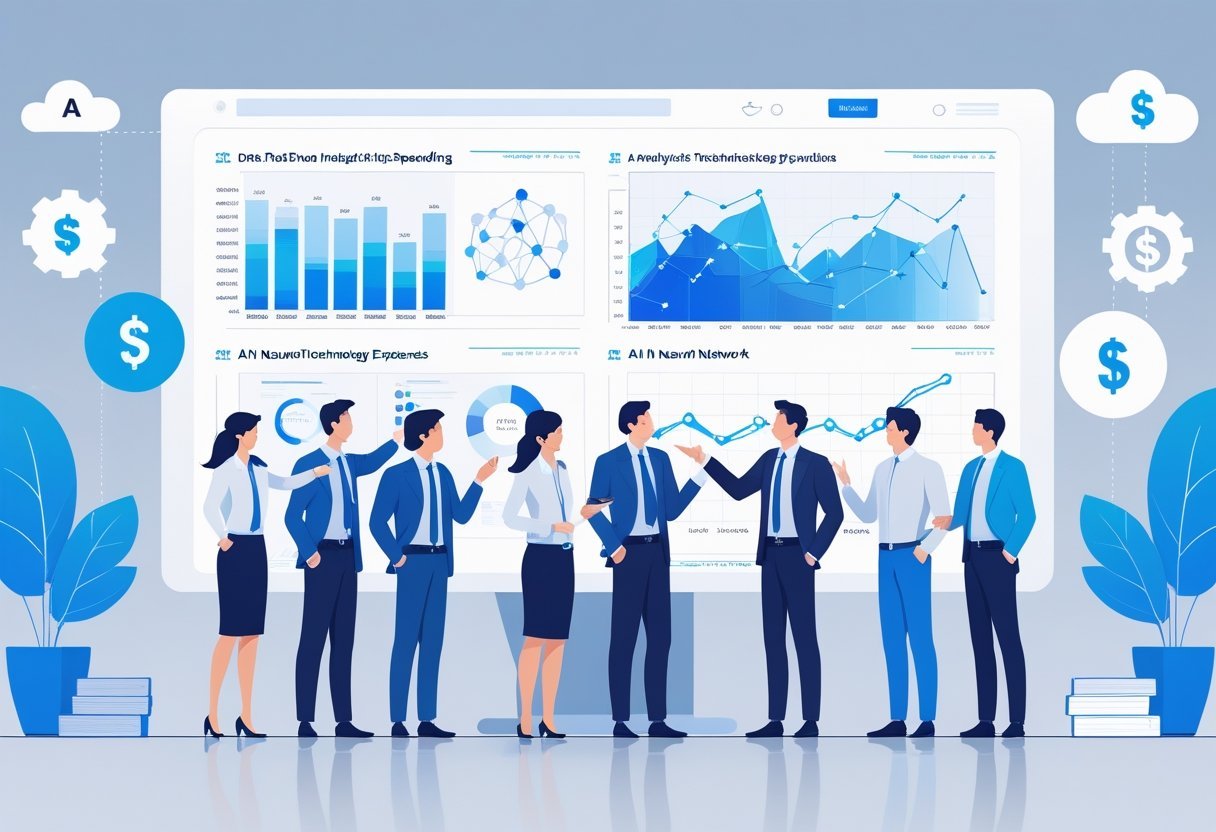
AI transforms raw spending data into clear insights that help you make smarter decisions about your technology budget. These tools analyze your current spending patterns, predict future costs, and help you plan for different financial scenarios.
Analyzing Technology Spending Patterns
AI systems examine your technology expenses to find areas where you're spending too much money. AI-powered spend analysis tools can identify patterns, predict future trends, and recommend cost-saving measures based on your data.
These tools look at several key areas in your spending:
- Duplicate services: Software subscriptions that do the same thing
- Unused licenses: Accounts you pay for but don't use
- Vendor pricing: Whether you're paying competitive rates
- Usage patterns: Which tools your team actually needs
The technology breaks down complex spending data into simple categories. You can see exactly where each dollar goes across departments, projects, and time periods.
This level of detail helps you spot problems like one team paying for expensive software while another team uses a cheaper option for the same task.
AI-Driven Predictive Analytics for Budgeting
Predictive analytics uses your past spending to forecast future costs. Companies that adopt automated cost modeling and AI-powered decision-making will be better positioned to anticipate market fluctuations and adjust their spending accordingly.
Your AI system learns from historical data to predict what you'll need. It factors in growth rates, seasonal changes, and market trends.
For example, if your company grows by 20% each year, the AI calculates how much extra cloud storage or software licenses you'll need. Should-cost models help you determine the true price of technology products and services.
These AI-powered tools capture real-world complexity better than older methods. They predict price changes by analyzing economic trends and supply chain issues.
The system alerts you before costs spike. You get time to negotiate better deals or find alternatives.
Scenario Planning and Financial Forecasting
AI helps you prepare for different budget situations. You can test what happens if your team grows, if software prices increase, or if you need to cut costs quickly.
The technology runs multiple scenarios at once:
| Scenario Type | What It Shows |
|---|---|
| Growth | Costs if you hire more people |
| Reduction | Where to cut without hurting productivity |
| Market shift | Impact of price changes from vendors |
| Project-based | Budget needs for new initiatives |
Data-driven insights let you benchmark your spending against similar companies. You see if you're paying more or less than others in your industry.
This information strengthens your position when negotiating with vendors. Your forecasting becomes more accurate over time.
The AI learns which factors matter most for your specific situation. You make decisions based on real numbers instead of guesses.
Transforming Business Processes With Advanced AI
AI reshapes how businesses operate by automating complex workflows, optimizing supply chains, and adjusting pricing in real-time. These changes directly cut technology costs while boosting operational performance.
AI Integration in Supply Chain Management
AI transforms supply chain management by predicting demand patterns and reducing waste across the entire logistics network. Machine learning algorithms analyze historical data to forecast inventory needs with greater accuracy than traditional methods.
This prevents overstocking that ties up capital and understocking that loses sales. Computer vision systems monitor warehouse operations and track shipments in real-time.
These systems identify damaged goods before they reach customers and optimize loading patterns to reduce shipping costs. You can also use AI to evaluate supplier performance and automatically flag delays or quality issues.
AI-powered business transformation requires redesigning workflows rather than just adding new tools. Your supply chain becomes more responsive when AI agents handle routine decisions like reordering and route optimization.
This frees your team to focus on strategic planning instead of daily operational tasks. The cost savings come from reduced inventory carrying costs, fewer expedited shipments, and better capacity planning across your distribution network.
Workforce and Process Automation
Robotic process automation handles repetitive tasks that consume employee time without adding strategic value. Your team no longer needs to manually enter data, reconcile invoices, or generate routine reports.
These systems work 24/7 without breaks and make fewer errors than manual processes. Intelligent process automation connects multiple technologies to create adaptive workflows.
You gain productivity gains of 40% or more in key areas when automation handles high-volume transactions. AI doesn't just speed up existing processes.
It identifies bottlenecks and suggests improvements that weren't visible before. Your customer service teams can resolve issues faster when AI retrieves relevant information automatically.
Finance departments close books quicker when AI reconciles accounts without human intervention. The technology spend reduction comes from doing more work with existing staff and eliminating the need for additional software licenses as volumes grow.
You also reduce error correction costs and compliance penalties.
Dynamic Pricing and Revenue Enhancement
AI analyzes market conditions, competitor pricing, and customer behavior to adjust your prices dynamically. This maximizes profitability without manual price reviews that take weeks to implement.
Your revenue optimization happens automatically based on demand signals. The systems consider dozens of variables simultaneously: inventory levels, seasonal patterns, customer segments, and competitive positioning.
You can test different pricing strategies across products and quickly identify what drives the best margins. AI also spots opportunities to bundle products or offer personalized discounts that increase conversion rates.
Cost transformation through AI extends beyond operational efficiency to revenue innovation. Your pricing becomes a competitive advantage rather than a static number in your system.
The technology investment pays for itself through increased margins and reduced revenue leakage. You capture value that would otherwise go to competitors or be lost through outdated pricing rules.
Real-World AI Implementation and Use Cases
Companies across industries are achieving measurable results from AI implementation, with 66% of CEOs reporting business benefits from generative AI initiatives. Organizations are using AI to automate repetitive tasks, streamline operations, and reduce technology costs through strategic deployments of tools like GitHub Copilot and chatbots.
Case Studies of AI-Driven Cost Reduction
Bancolombia achieved a 30% increase in code generation productivity using GitHub Copilot, leading to 18,000 automated application changes per year and 42 daily deployments. This reduced development time and lowered labor costs significantly.
Bank CenterCredit cut analytics time by 50% and reduced report errors by 40% after deploying Microsoft Fabric and Power BI. Employees saved 800 hours per month, which translated directly into reduced operational expenses.
Crediclub saved 96% per month in auditing expenses by implementing Azure OpenAI Service. The system analyzed 150 meetings per hour, freeing up 800 sales advisors and 150 branch managers to focus on customer interactions instead of administrative tasks.
BNY reported faster code development after 80% of its developer community adopted GitHub Copilot for daily use. The tool reduced development cycles and lowered the need for additional engineering resources.
Innovation Leaders in Technology Spend Optimization
BlackRock deployed over 24,000 Microsoft 365 Copilot licenses across all functions and locations. The investment demonstrates how financial institutions are prioritizing AI investments to reduce long-term technology costs.
Commonwealth Bank of Australia equipped 10,000 employees with Microsoft 365 Copilot, with 84% reporting they wouldn't return to working without it. The bank saw 30% of GitHub Copilot code suggestions adopted, reducing development time and costs.
Allpay increased productivity by 10% and delivery volume by 25% using GitHub Copilot. Engineers now write code faster with less effort, reducing project timelines and associated expenses.
Petrobras created Chat Petrobras using Azure OpenAI Service for its 110,000 employees. The chatbot streamlined workflows, reduced manual tasks, and summarized reports, cutting administrative overhead significantly.
Challenges and Best Practices in AI Implementation
Your AI implementation requires careful planning around risk tolerance and foundational investments like data cleansing and model training. The riskiest transformations remove humans from decision-making loops entirely.
Best Practices for Success:
- Start with phased rollouts to gather user feedback
- Invest in employee training on prompt writing and tool adoption
- Establish governance frameworks like centers of excellence
- Focus on specific business needs rather than broad deployments
- Measure productivity gains through concrete metrics
Brisbane Catholic Education saved teachers 9.3 hours per week by providing proper training on Microsoft 365 Copilot and Copilot Studio. Training programs ensure employees understand how to use AI tools effectively, maximizing your return on investment.
Centrica grew from 300 apps to over 800 business solutions using Microsoft Power Platform. Their center of excellence maintains governance while supporting 330 makers and 15,000 users, demonstrating how structured oversight reduces implementation risks.
Future Trends and Long-Term Impact of AI on Technology Spend
AI will reshape how you manage technology budgets through automated systems, compliance tools, and smarter investment strategies. These changes will affect everything from code generation to how you handle regulatory requirements.
Emerging Generative AI Solutions
Generative AI is already changing how your development teams work. At Google, around 25 percent of new code is developed using AI, which shows the real impact of these tools.
You can expect your developers to shift from writing code to defining architecture and reviewing AI-generated output. This means junior developers can now handle tasks that once required years of experience.
One health care company used AI to help a junior developer with no COBOL experience generate an explanation file with 95% accuracy. Key cost savings come from:
- AI-assisted code generation
- Automated testing processes
- Rapid data analytics
- Reduced need for offshore development
The productivity gains from coding alone could be worth $12 billion in the United States. Your technology investments will increasingly focus on AI tools that accelerate search, prototyping, and learning cycles while keeping humans involved for critical decisions.
Regulatory Changes and Compliance Savings
AI can help you navigate the growing complexity of compliance requirements while cutting costs. Automated policy generation and real-time monitoring reduce the manual work your teams spend on regulatory tasks.
You'll see AI handle data masking, incident response, and authentication processes. This becomes critical as digital transformation expands your attack surfaces and regulatory obligations.
AI-powered systems can detect anomalies and generate compliance reports faster than manual processes. AI could reduce federal deficits by $400 billion over ten years through improved efficiency.
Your organization can apply similar principles to cut compliance costs. Machine learning algorithms will predict regulatory changes and help you prepare in advance.
Natural language processing tools can scan new regulations and flag what affects your operations.
Evolving Strategies for Maximizing Technology Investments
Your IT budget is shifting from maintenance to growth-focused spending. You need to reallocate resources as AI handles routine tasks and frees up capacity for innovation.
Cloud financial operations will become smarter through AI. Real-time cost analysis and pattern detection across systems help you optimize spending automatically.
This matters because AI itself may drive up your cloud costs significantly in coming years. Smart investment strategies include:
- Upskilling existing talent instead of hiring
- Using AI for personalized learning paths
- Implementing autonomic infrastructure that self-manages
- Deploying low-code platforms for citizen developers
You should prepare for IT to transition toward an internal service model. Your teams will provide reusable code blocks and platforms that business units use to develop their own solutions.
This means technology becomes a competitive advantage rather than just a cost center. AI algorithms will handle resource allocation, predictive maintenance, and anomaly detection.
Your role shifts to oversight and strategic direction while automated systems manage daily operations.
Frequently Asked Questions
AI adoption for technology cost reduction requires understanding specific implementation strategies and measurable outcomes. Companies need clear answers about deployment methods, financial returns, and operational improvements.
What approaches do companies implement to leverage AI for cost reduction?
Companies start with pilot projects that deliver fast value before expanding to larger deployments. This phased approach lets you test AI solutions on a smaller scale and measure results before committing more resources.
You should conduct an AI readiness assessment to identify where AI can make the biggest impact on your costs. This evaluation helps you understand your current technology infrastructure and find gaps that AI can fill.
Many businesses focus on customer experience and engagement as a top ROI use case, with adoption in this area jumping from 25% to 60%. Digital assistants powered by AI can handle customer interactions at scale without requiring proportional increases in staff.
In what ways can AI drive cost transformation within an organization?
AI transforms costs by reducing labor hours spent on repetitive tasks. Your employees can complete work faster and with less strain when AI handles routine processes.
You can deploy AI both as agent-facing tools for your staff and as customer-facing autonomous agents. These tools work across your employee experience, business operations, hiring processes, and supply chain management to create comprehensive cost savings.
According to a 2024 survey of 4,000 business leaders, every dollar invested in AI returns about 3.7 times the investment. Data from financial services companies shows AI drives a 5% increase in revenue and a 5% reduction in annual costs.
How does the integration of AI in business operations enhance cost efficiency?
AI integration improves efficiency by automating workflows and streamlining communications across departments. Your teams can access information faster and make decisions based on better data analysis.
You gain cost efficiency when AI handles tasks that previously required human time and attention. This frees your employees to focus on higher-value work that requires human judgment and creativity.
The technology helps you spot problems before they become expensive issues. AI enables continuous and proactive management of technical systems by identifying and fixing problems early.
What are the long-term financial benefits of adopting AI technologies for businesses?
Your business gains sustainable cost reductions that compound over time. AI systems get better at their tasks as they process more data and learn from patterns.
You avoid the escalating costs that late adopters face. Companies that delay AI adoption experience widening skill gaps and higher implementation costs later.
AI investments protect you against competitive disadvantages. Your customers expect digital experiences that match or exceed what your competitors offer, and AI helps you meet those expectations efficiently.
Can you explain the role of AI in streamlining business processes to reduce overhead?
AI reduces overhead by taking over repetitive tasks that consume employee time. Your staff spends less time on data entry, basic customer inquiries, and routine analysis.
You eliminate redundant processes when AI identifies inefficiencies in your workflows. The technology can map how work moves through your organization and suggest improvements.
Your hiring and training costs decrease because AI assistants help employees perform better. In fact, 44% of employees would be more likely to quit if their company didn't allow AI assistants, and 59% prioritize applying for jobs at companies that allow AI use.
What are the strategic steps businesses should take to effectively use AI for spending optimization?
Start by establishing clear benchmarks and KPIs for tracking ROI and other metrics. You need specific numbers to measure whether your AI investments deliver the promised returns.
Develop comprehensive training programs for your employees. Your staff needs to understand how to use AI tools safely and effectively.
Create risk and governance frameworks that include human oversight. This protects you from errors while ensuring your AI systems operate within your company's standards and values.
Work with an experienced partner who can provide expertise, technology, and economies of scale. This approach lets you benefit from proven implementations.