
Planning for retirement used to mean sitting down with a financial advisor and working through spreadsheets for hours. Now artificial intelligence can help you estimate how much money you'll need, suggest how much to save each month, and adjust your plan as your life changes. AI tools can analyze your spending habits, income, and goals to create a personalized retirement strategy that updates in real time as your situation evolves.

You don't need to be a tech expert to benefit from AI for retirement and financial planning. Many apps and platforms you might already use have AI built in to help with budgeting, investing, and long-term planning. These tools can handle complex calculations instantly and show you different scenarios based on your choices.
The key is knowing which AI tools to use and how to get the most out of them. This guide will show you how to use AI to plan your retirement step by step, from setting your goals to managing your investments and avoiding common mistakes along the way.
Key Takeaways
- AI tools can create personalized retirement plans based on your income, expenses, and lifestyle goals
- You can use AI to estimate retirement needs, optimize savings rates, and manage investment portfolios automatically
- AI recommendations should serve as a starting point that you review and adjust based on your specific situation
The Role of AI in Modern Retirement Planning
Artificial intelligence is transforming how you approach retirement planning by analyzing data faster, creating personalized strategies, and identifying risks that might affect your financial future. The technology works alongside human advisors to improve accuracy and efficiency in building retirement plans.
The Evolution of Retirement Planning with Artificial Intelligence
Retirement planning has shifted from manual calculations to AI-powered analysis systems. In the past, you relied on basic calculators and spreadsheets to estimate your retirement needs. Now, AI algorithms can process thousands of data points in seconds.
The technology examines your spending habits, income sources, and retirement goals to build customized projections. Machine learning models learn from your financial behavior and adjust recommendations as your situation changes.
AI tools can run multiple retirement scenarios simultaneously. You can test different variables like early retirement dates, unexpected medical costs, or market downturns. This lets you see how various factors might impact your financial plan before making decisions.
How AI Enhances Financial Decision Making
AI improves your retirement plan through three main capabilities: speed, accuracy, and personalization. The technology processes market data and economic trends in real time, helping you spot opportunities or risks quickly.
Artificial intelligence creates tailored financial strategies based on your unique circumstances. It considers factors like:
- Your current age and retirement timeline
- Expected Social Security benefits
- Healthcare cost projections
- Investment risk tolerance
- Tax implications
The automation handles repetitive tasks like portfolio rebalancing and expense tracking. This frees up time for you to focus on bigger financial decisions. AI also flags potential problems, such as insufficient savings or portfolio risks, before they become serious issues.
Combining Human Expertise with AI Tools
AI complements rather than replaces human financial advisors. You get the best results when you combine automated analysis with professional guidance. The technology handles data processing while advisors provide judgment and context.
Financial advisors use AI to verify their recommendations and explore alternatives they might not have considered. You benefit from both the speed of automation and the experience of a trained professional who understands your personal situation.
AI serves as a planning assistant that you can access anytime. You can ask questions about Social Security benefits or estimate healthcare costs without scheduling an appointment. The technology provides consistent support as you navigate financial transitions, but you still need human judgment for major decisions about your retirement strategy.
Essential AI Tools and Platforms for Retirement

Several AI platforms now offer retirement planning features that range from basic calculators to full portfolio management. These tools include robo-advisors that automate your investments, chatbots that answer financial questions, and specialized apps that forecast your retirement readiness.
Comparing Top AI-Powered Retirement Apps
Multiple AI-powered retirement planning platforms offer distinct features for different needs. Empower tracks your net worth and provides personalized investment advice through a dashboard that consolidates all your accounts. Fidelity includes retirement planning tools that forecast your savings growth based on your income, age, and goals.
NewRetirement specializes in detailed retirement scenario modeling. You can adjust variables like retirement age, spending levels, and Social Security timing to see how changes affect your plan.
M1 Finance uses rule-based automation to rebalance portfolios and manage IRAs. Capitalize helps you roll over old 401(k)s into IRAs using an AI-assisted platform that automates paperwork and locates forgotten retirement accounts.
Robo-Advisors and Automated Financial Planning
Robo-advisors use algorithms to manage your retirement investments automatically. These platforms build diversified portfolios based on your age, risk tolerance, and retirement timeline.
Betterment adjusts your asset allocation as you age, shifting from stocks to bonds as retirement approaches. Wealthfront offers tax-loss harvesting and direct indexing to reduce your tax bill. Both charge low fees compared to human financial advisors.
Fidelity Go provides automated portfolio management specifically for retirement accounts. The service rebalances your investments and manages contributions without requiring you to make trading decisions.
These robo-advisors typically charge between 0.25% and 0.50% of your assets annually. Many have no account minimums or very low requirements to start.
AI Chatbots for Personalized Financial Advice
ChatGPT serves as a starting point for retirement planning questions when you can't afford a financial advisor. You can ask specific questions like “If I have $200,000 saved at age 35 and contribute $500 monthly with a 10% return, how much will I have at 55?”
The chatbot can then help you explore follow-up scenarios. You might ask how your retirement changes if you reduce contributions or how inflation affects your spending power.
AI chatbots pull from large amounts of financial data to give you clear insights without sales quotas or emotional bias. They explain concepts like Roth IRAs in plain language.
However, never share account numbers or login credentials with general AI chatbots. These tools aren't designed to securely store your personal financial data.
Emerging AI Platforms Shaping the Future
New AI platforms are integrating spending analysis with retirement forecasting. Some credit unions now use AI to predict your monthly budget patterns and automatically adjust retirement contribution recommendations.
AI-powered spending simulators analyze your past habits, location, and lifestyle goals to project your actual future expenses. These tools factor in inflation trends and regional cost differences to give more accurate retirement needs estimates.
Machine learning models can now simulate multiple economic scenarios simultaneously. They show how job losses, market downturns, or unexpected healthcare costs might affect your retirement timeline. This helps you build backup plans before problems occur.
Building an AI-Driven Retirement Strategy
AI tools analyze your financial data to create personalized retirement strategies based on your spending patterns, income, and goals. These systems use machine learning to optimize your portfolio and run thousands of scenarios to test your retirement readiness under different market conditions.
Setting Retirement Goals and Milestones with AI
AI retirement planning starts by analyzing your current financial situation and desired lifestyle. You input your age, income, expenses, and target retirement age into the system. The AI then calculates your specific retirement number based on your actual spending patterns rather than generic rules.
AI-powered forecasting delivers 50% better accuracy than manual estimation because it examines years of your transaction data. The system identifies which expenses will continue in retirement and which will disappear. For example, if you spend $5,000 monthly now, AI might determine you'll need $3,800 in retirement after accounting for eliminated commuting costs and paid-off mortgages.
AI creates measurable milestones along your path to retirement. You receive specific targets like “save $450,000 by age 50” or “increase 401(k) contributions to 12% by next year.” The system tracks your progress continuously and alerts you when you drift off course.
Data-Driven Budget Forecasting and Expense Projections
AI examines your historical spending to predict realistic retirement expenses. The technology categorizes every transaction and identifies patterns in how you spend money. This creates accurate projections for healthcare costs, housing, travel, and daily living expenses.
The system runs scenario planning to test different possibilities. You can instantly model questions like “What if I retire at 62 versus 67?” or “How does buying a vacation home affect my plan?” AI recalculates your retirement readiness probability for each scenario.
Budget forecasting tools also factor in inflation, healthcare cost increases, and life expectancy. Different AI tools use different machine-learning models, so choosing one that fits your planning style matters. The AI updates projections as your income changes or you experience major life events.
Portfolio Optimization Through Machine Learning
Machine learning algorithms adjust your investment allocation based on your risk tolerance and years until retirement. Instead of following age-based rules like “100 minus your age equals stock percentage,” AI considers current market valuations, your specific goals, and your comfort with volatility.
The system performs tax-loss harvesting automatically to reduce your tax burden. It also calculates the most efficient withdrawal strategy across your 401(k), Roth IRA, and taxable accounts to minimize lifetime taxes.
AI-driven robo-advisors manage 30% of investments by 2025, offering sophisticated tax optimization. These platforms rebalance your portfolio automatically to maintain target allocation as markets move. You receive alerts when the AI recommends changes to keep your retirement plan on track.
Maximizing Retirement Savings with AI Guidance
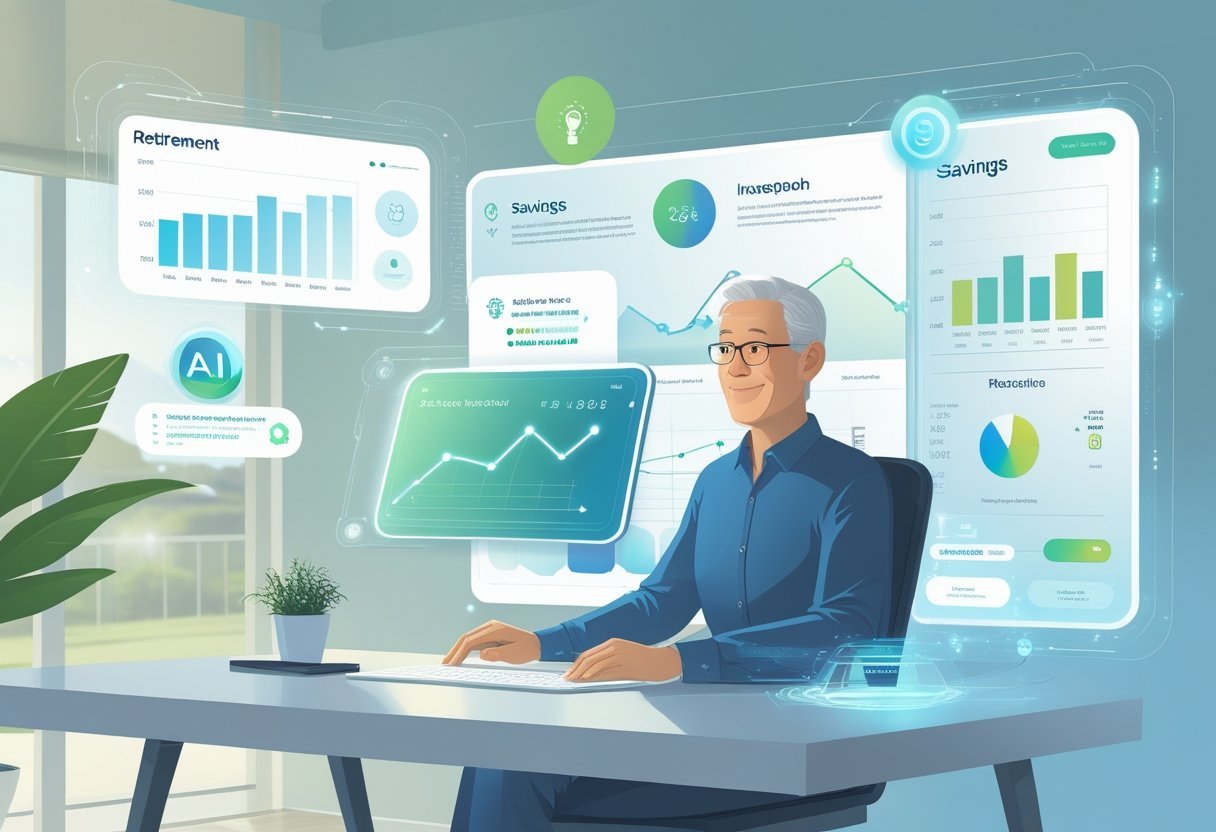
AI tools analyze your income, expenses, and financial goals to determine optimal contribution amounts and account strategies. These technologies can identify opportunities for catch-up contributions, evaluate Roth conversion benefits, and create personalized Social Security claiming strategies based on your specific situation.
Automated Savings and Contribution Optimization
AI platforms monitor your cash flow patterns to identify how much you can save each month without straining your budget. The technology adjusts your retirement savings contributions automatically based on income changes, bonus payments, or reduced expenses.
Many AI systems calculate the exact percentage you should contribute to your 401(k) to capture the full employer match. They also determine whether to split contributions between traditional and Roth accounts based on your current tax bracket and projected retirement income.
AI algorithms analyze your spending habits to predict future expenses and recommend contribution increases when you can afford them. The software tracks contribution limits across all your retirement accounts to prevent over-contributing while maximizing your annual savings potential.
Choosing and Managing Retirement Accounts
AI evaluates whether a traditional IRA or Roth IRA better suits your tax situation by comparing your current marginal rate against projected retirement tax brackets. The technology considers factors like expected Social Security benefits, pension income, and required minimum distributions.
For 401(k) accounts, AI tools assess your plan's investment options and fee structures. They recommend specific fund allocations based on your risk tolerance and retirement timeline. The systems also identify when rolling over old 401(k) accounts into an IRA might reduce fees or expand investment choices.
AI platforms help you coordinate multiple retirement accounts to avoid duplicating investments or creating tax inefficiencies. They track contribution limits separately for 401(k), IRA, and Roth IRA accounts to ensure you maximize each account type's annual limits.
Catch-Up Contributions and Roth Conversions
Once you reach age 50, you can make catch-up contributions of $7,500 to your 401(k) and $1,000 to your IRA. AI calculates whether these additional contributions make sense based on your retirement readiness and current financial capacity.
The technology identifies optimal years for Roth conversions by analyzing your income fluctuations. If you have a lower-income year due to job loss or reduced work hours, AI may recommend converting traditional IRA funds to a Roth IRA while you're in a lower tax bracket.
AI tools model the long-term tax impact of Roth conversions by projecting your future required minimum distributions and tax liability. They can spread conversions across multiple years to avoid pushing you into higher tax brackets while still moving assets to tax-free growth.
Social Security and Income Distribution Strategies
AI analyzes when you should claim Social Security benefits by comparing claiming at age 62 versus waiting until 70. The technology factors in your life expectancy, other income sources, and whether you're married to determine the optimal claiming age.
For couples, AI creates coordinated claiming strategies that maximize lifetime benefits. This might involve having the lower-earning spouse claim early while the higher earner delays to age 70.
The technology designs withdrawal sequences that minimize taxes by determining which accounts to tap first. AI typically recommends withdrawing from taxable accounts before touching tax-deferred retirement accounts, allowing your 401(k) and IRA balances to grow longer. It also calculates annual withdrawal amounts that keep you in lower tax brackets while meeting your spending needs.
AI-Driven Investment Management and Tax Planning
AI tools now handle complex investment decisions and tax strategies that once required expensive financial advisors. These platforms analyze your portfolio in real time, suggest specific tax-saving moves like Roth conversions, and model how your retirement savings will perform under different economic conditions.
AI in Investment Portfolio Management
AI-powered platforms continuously monitor your investments across all accounts to spot problems and opportunities. AI-driven robo-advisors create diversified portfolios based on your risk tolerance and rebalance them automatically when allocations drift from targets.
These systems track hidden risks that you might miss. For example, some platforms use X-Ray features to reveal when you own the same stock across multiple funds, creating dangerous concentration. The AI flags these overlaps and suggests adjustments.
Real-time recommendations help you respond to market changes without emotional reactions. The algorithms calculate whether to sell underperforming assets, when to harvest losses, and how to maintain diversification. This removes guesswork from portfolio management while keeping costs lower than traditional financial planners charge.
Tax Optimization and Roth Conversion Strategies
AI-powered tax planning software identifies specific opportunities to reduce your tax burden throughout retirement. These tools model Roth conversion scenarios across different timelines to show when moving money from traditional IRAs makes financial sense.
The software calculates optimal Social Security claiming ages based on tax efficiency, not just benefit amounts. It also projects required minimum distribution impacts years before you turn 73, helping you plan withdrawals that minimize taxes.
Advanced platforms prevent wash sales by tracking purchases and sales across all your accounts. When you sell an investment at a loss, the AI ensures you don't accidentally repurchase the same security within 30 days, which would eliminate your tax deduction. Daily tax-loss harvesting captures these opportunities automatically throughout the year.
Scenario Analysis for Market Volatility and Inflation
AI models test how your retirement plan performs under various economic conditions before they happen. You can see projections showing your portfolio's value during high inflation periods, market crashes, or rising interest rates.
These scenario analysis tools factor in your current savings, expected contributions, withdrawal rates, and asset allocation. They calculate how long your money lasts if inflation runs at 2%, 4%, or 6% annually. The models also show whether your investments can sustain market drops of 20% or more without forcing you back to work.
You can adjust variables to see immediate results. Change your retirement age, modify your spending, or shift your asset mix to understand trade-offs. This helps you build a plan that survives different economic scenarios rather than hoping for ideal conditions.
Risks, Limitations, and Responsible Use of AI in Retirement
AI tools can help with retirement planning, but they come with real risks around data security, accuracy limitations, and the need for human oversight. Understanding these challenges helps you use AI safely while protecting your financial future.
Understanding the Boundaries of AI Financial Advice
AI systems analyze data using algorithms but have limitations in decision-making that affect retirement planning accuracy. These tools work best for identifying patterns and crunching numbers. They struggle with nuanced situations like sudden health issues, family changes, or market conditions that fall outside their training data.
AI cannot replace the personalized financial advice that comes from understanding your complete life situation. It might suggest a standard withdrawal rate without considering your specific medical needs or family obligations. The technology also lacks the ability to adapt quickly when economic conditions change in unexpected ways.
Key AI limitations include:
- Inability to process emotional factors in financial decisions
- Difficulty handling unique or complex financial situations
- Lack of accountability when recommendations lead to losses
- Limited understanding of personal values and priorities
Protecting Financial Data and Privacy
Your retirement accounts contain sensitive information that hackers target. AI platforms require access to your financial data to provide recommendations, creating potential security vulnerabilities. You need to verify that any AI tool uses encryption and follows strict data protection standards.
Many AI services store your information on cloud servers. Read the privacy policy carefully to understand who can access your data and how long they keep it. Some platforms sell anonymized user data to third parties, which could expose patterns about your wealth and spending habits.
Protect yourself by:
- Using AI tools from established financial institutions with strong security records
- Enabling two-factor authentication on all accounts
- Avoiding platforms that request unnecessary personal information
- Regularly reviewing your account activity for suspicious changes
Never share your full Social Security number or account passwords with AI chatbots, even those claiming to offer financial education.
The Importance of Human Judgement in AI Retirement Planning
Americans still want a human in the loop for life-changing retirement decisions, and for good reason. Financial advisors bring experience with real clients who faced similar challenges. They understand risk management beyond what algorithms calculate and can spot warning signs that AI might miss.
Human advisors adjust their guidance based on conversations with you. They notice when you seem worried about market volatility or uncertain about long-term care needs. This emotional intelligence matters when making decisions that affect decades of your life.
Working with both AI and human advisors creates a balanced approach. Use AI for quick calculations and initial research. Then discuss the results with a qualified financial advisor who can evaluate whether the recommendations fit your actual needs. This combination gives you the efficiency of technology with the wisdom of professional financial planning experience.
Frequently Asked Questions
AI retirement planning raises important questions about tool selection, risk management, and income security. Understanding how artificial intelligence calculates savings needs and manages investments helps you make informed decisions about your retirement future.
What are the best AI tools available for retirement planning?
Several AI-powered platforms stand out for retirement planning in 2025. Wealthfront and Betterment offer robo-advisory services that automatically manage your retirement investments using AI algorithms. These platforms typically charge around 0.25% annually and handle portfolio rebalancing based on your age and risk tolerance.
Personal Capital provides free AI retirement planning tools that use Monte Carlo simulations to calculate your success probability. The platform analyzes your current accounts and projects whether you'll meet your retirement goals based on different market scenarios.
Compordo integrates AI retirement projections with daily budgeting and spending analysis. The tool costs $9.99 per month for premium features and creates personalized recommendations based on your actual financial patterns rather than generic assumptions.
Different AI tools use different machine-learning models, so you need to understand which one fits your specific situation. Some focus purely on investment management while others provide comprehensive financial planning that includes retirement savings tracking.
How can artificial intelligence enhance pension fund management?
AI improves pension fund management through predictive analytics and automated portfolio optimization. The technology analyzes market trends, economic indicators, and risk factors faster than human managers can process them. This leads to more timely investment decisions and better risk management.
Machine learning algorithms can identify patterns in historical data to forecast market movements. Pension funds use these insights to adjust asset allocation before major market shifts occur. The result is often better protection against downturns and improved long-term returns.
AI also reduces management costs by automating routine tasks like rebalancing and compliance monitoring. By 2025, 30% of investments are managed by AI-driven robo-advisors, many with sophisticated tax optimization capabilities. Lower fees mean more money stays in your retirement accounts.
Dynamic asset allocation through AI adjusts your portfolio based on actual market conditions rather than simple age-based rules. Traditional advice might say to hold 70% stocks at age 30, but AI considers current market valuations, your risk tolerance, and economic outlook to make more nuanced decisions.
What is the role of ChatGPT or similar AI in calculating retirement savings?
ChatGPT and similar conversational AI tools help you ask the right questions about retirement planning. Retirement requires you to ask yourself the right questions, and AI can guide you through critical considerations like healthcare costs, desired lifestyle, and income sources.
These tools can perform basic retirement calculations when you provide your age, income, current savings, and desired retirement age. ChatGPT can explain complex financial concepts in simple terms and help you understand how different factors affect your retirement needs.
The limitation is that general AI chatbots don't connect to your actual financial accounts. They can't analyze your real spending patterns or track your progress over time. You need to manually input all data, which increases the chance of errors or outdated information.
Conversational AI works best as an educational tool to understand retirement concepts and explore different scenarios. For actual retirement planning and ongoing management, you should use specialized AI retirement platforms that connect directly to your accounts and provide continuous monitoring.
Are there any risks associated with relying on AI for retirement strategies?
AI retirement planning tools make assumptions about future market returns, inflation rates, and your life expectancy that might not prove accurate. No algorithm can perfectly predict decades of economic conditions or personal circumstances. You need to understand that AI provides probability-based guidance, not guarantees.
AI can be deceptively dangerous if you rely on it blindly without understanding the underlying assumptions. Different tools may produce different recommendations based on their programming and data sources. A single AI tool shouldn't be your only source of retirement advice.
Data privacy presents another concern when connecting all your financial accounts to AI platforms. You're sharing sensitive information about your income, spending, and assets. Make sure any AI tool you use employs strong encryption and has clear privacy policies about how your data is stored and used.
AI systems can also have built-in biases based on the data they were trained on. If the training data primarily reflects certain demographics, the recommendations might not suit your unique situation. Review AI suggestions critically rather than following them automatically.
Market volatility can expose limitations in AI models. During unprecedented economic events, AI trained on historical data may not respond appropriately to conditions it has never encountered before. Keep some human oversight in your retirement planning process.
How can retirees ensure they have adequate income using AI-based investments?
AI-based robo-advisors can optimize withdrawal strategies to make your retirement savings last longer. These tools calculate the most tax-efficient way to draw money from different account types like traditional IRAs, Roth IRAs, and taxable accounts. Proper sequencing can save you thousands in taxes over your retirement.
Set up quarterly reviews of your AI-managed retirement accounts to verify the recommendations align with your current needs. Your spending patterns and health status may change during retirement, requiring adjustments that AI might not automatically detect without updated input from you.
Diversification remains critical even with AI management. Make sure your AI-selected portfolio includes a mix of stocks, bonds, and other assets appropriate for your age and risk tolerance. Most AI platforms adjust your allocation automatically as you age, becoming more conservative to protect your accumulated wealth.
Use AI tools to model different spending scenarios before you retire. Test whether your savings can support your desired lifestyle for 20, 25, or 30 years. AI can run thousands of simulations to show your probability of success under various market conditions and spending levels.
Consider keeping 1-2 years of living expenses in cash or stable investments outside AI management. This buffer protects you from having to sell investments during market downturns and gives you peace of mind that immediate needs are covered regardless of AI performance.
What advancements in AI should individuals consider when preparing for retirement?
Predictive spending analysis represents a major advancement in AI retirement planning. Modern tools analyze years of transaction data to forecast your realistic retirement expenses with 50% better accuracy than manual estimation. This helps you set more realistic savings targets based on your actual lifestyle rather than generic percentages.
Social Security optimization through AI has become more sophisticate