
AI is changing from a tool that answers questions into a partner that works alongside people. In 2026, you can use AI as digital coworkers that handle specific tasks, create content across multiple formats, and help solve complex problems in healthcare, science, and business while you focus on strategy and creativity. The technology is moving beyond simple automation to true collaboration.
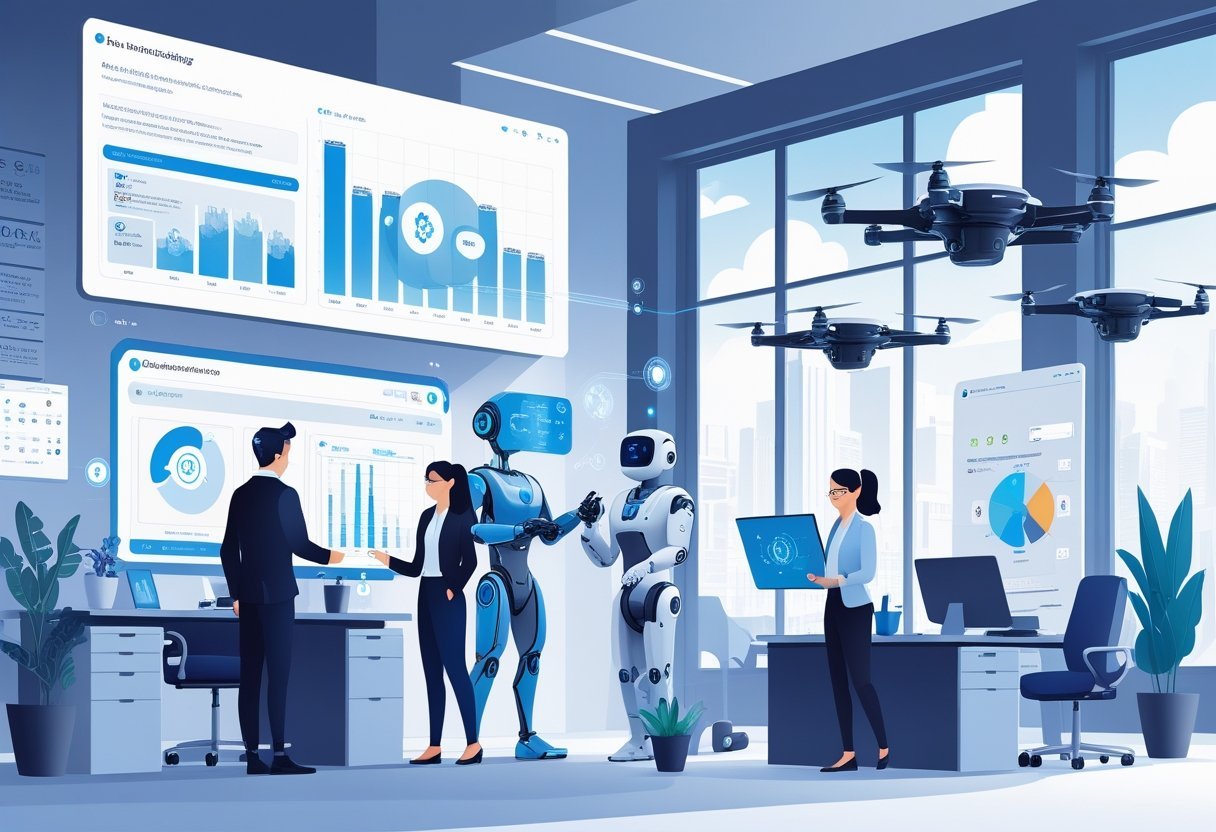
This shift means AI agents will join workforces as teammates rather than just software programs. Small teams can now accomplish what once required large departments. A three-person group can launch global campaigns in days with AI handling data work and content generation while humans guide the creative direction.
The ways you can apply artificial intelligence in 2026 span from everyday business tasks to scientific breakthroughs. You'll find AI helping with medical diagnoses, running lab experiments, writing and testing code, and even working on quantum computing problems. Security and trust are becoming built-in features as these systems take on more responsibility in your daily work.
Key Takeaways
- AI in 2026 functions as a collaborative partner that amplifies your capabilities rather than replacing human work
- You can deploy AI agents as digital teammates that handle specialized tasks while you maintain strategic control
- Artificial intelligence applications now extend across industries from healthcare and scientific research to software development and creative work
AI-Augmented Workforce and Human-AI Collaboration
Companies are building partnerships between people and AI tools to handle daily work tasks. Workers now use AI assistants to reduce repetitive work while focusing on tasks that need human judgment and creativity.
AI Copilots in the Workplace
AI copilots work alongside you to handle routine tasks and speed up your workflow. These tools integrate directly into the software you already use for writing, coding, data analysis, and customer service.
Microsoft Copilot assists with document creation and email management. GitHub Copilot helps programmers write code faster. ChatGPT answers questions and generates content across multiple formats.
The AI-augmented workforce uses these tools to reduce repetitive tasks, improve quality, and complete work faster. You spend less time on administrative work and more time on strategic decisions. AI handles data entry, scheduling, and basic research while you focus on problem-solving and client relationships.
Your role shifts from doing every task yourself to managing AI tools that handle the groundwork. You review AI outputs, make final decisions, and add the human touch that machines cannot replicate.
Redefining Roles and Skills
Your job responsibilities are changing as AI takes over specific tasks within your role. Rather than replacing entire positions, AI is automating the work around work and leaving human value at the center.
Skills becoming more important:
- Critical thinking and judgment
- AI tool management
- Creative problem-solving
- Emotional intelligence
- Strategic planning
Skills being automated:
- Data entry and processing
- Basic report generation
- Routine scheduling
- Simple customer inquiries
- Document formatting
Executives expect generative AI to change employee roles and skills, with lower-level employees seeing the biggest shifts. You need to develop AI literacy to understand what these tools can and cannot do. This knowledge helps you decide when to use AI and when human expertise matters more.
Prompt Engineering as a Key Competency
Prompt engineering is your ability to communicate effectively with AI systems. You write clear instructions that tell AI tools exactly what you need them to produce.
A basic prompt asks “Write a product description.” A skilled prompt specifies “Write a 100-word product description for a waterproof hiking backpack targeting outdoor enthusiasts, highlighting durability and storage capacity in a conversational tone.”
Effective prompt techniques:
- Be specific about format, length, and style
- Provide context and background information
- Include examples of desired outputs
- Break complex requests into steps
- Iterate and refine based on results
You need this skill regardless of your industry. Marketing teams craft prompts for content generation. Analysts write prompts for data interpretation. Developers use prompts to generate and debug code.
Human-AI collaboration becomes standard when you master prompt engineering. Your ai skills determine how much value you extract from AI tools. The better your prompts, the better your results and the more productive you become.
Autonomous and Agentic AI Systems
Agentic AI represents a shift from systems that simply respond to AI that takes independent action. These autonomous agents can plan tasks, make decisions, and execute complete workflows without constant human input.
Rise of AI Agents for Business Operations
AI agents are becoming digital workers in your organization. Unlike traditional AI that waits for your prompt, agentic AI takes actions, executes workflows, and completes projects end-to-end.
You can deploy these autonomous agents across different business functions. They handle customer service inquiries, process invoices, manage inventory, and update databases. The agents work 24/7 without breaks or supervision.
Your security focus needs to change too. The primary concern shifts from data protection to intent security, making sure AI systems act according to your company goals and policies. You need to verify that agents make decisions aligned with your business objectives.
Agentic AI Workflows
Your AI agents can now handle complex multi-step processes. They break down large projects into smaller tasks, complete each step, and move forward based on results.
Key workflow capabilities include:
- Planning: Agents map out task sequences and dependencies
- Execution: They perform actions across multiple software systems
- Adaptation: Agents adjust their approach based on changing conditions
- Coordination: They manage handoffs between different processes
You don't need to program every scenario. These systems move beyond automation into true autonomy, learning from outcomes and refining their methods. Your agents improve their performance over time without additional training from your team.
Multi-Agent Collaboration
Your business can run multiple AI agents that work together. Each agent specializes in specific tasks while communicating with others to achieve shared goals.
Think of it as a digital team. One agent gathers customer data, another analyzes purchasing patterns, and a third generates personalized recommendations. They share information and coordinate actions in real time.
This approach works beyond software too. Autonomous vehicles, drones, and robots use similar multi-agent systems. Self-driving ecosystems coordinate decisions and adapt together.
You maintain control through AI Ops platforms that monitor agent behavior and performance. These tools let you set boundaries, track decisions, and intervene when needed.
Generative AI: Content, Innovation, and Video
Generative AI tools are transforming how you create content, produce videos, and generate data for testing and analysis. These technologies cut production costs while opening new creative possibilities across entertainment, gaming, and business applications.
Generative AI in Creative Industries
Generative AI is reshaping industries from entertainment to healthcare in 2026. You can now use these tools for research, content creation, and even companionship in your daily workflow.
Netflix brought generative AI into mainstream television with the show El Eternauta. The producers cut their production time and costs compared to traditional animation methods.
In 2026, you'll see generative AI powering more big-budget TV shows and Hollywood productions. Gaming is becoming another exciting frontier where developers create stories that adapt to your actions in real time.
Game characters no longer follow scripts. They respond and hold conversations like real people, which creates richer experiences while cutting studio costs.
Mainstreaming Generative Video
Generative video technology is reaching maturity in 2026. You can now produce high-quality video content at a fraction of traditional costs.
Studios and marketers are producing AI-generated content that rivals traditional production quality. This technology helps independent creators compete with major studios by removing technical and financial barriers.
You'll notice this shift across social media platforms where video creation is surging. The tools let you generate professional-looking content without expensive equipment or large production teams.
Synthetic Data and Simulation
Synthetic data is becoming essential fuel for analytics and automated systems. You can use generative AI to create the raw data needed to understand complex systems without exposing sensitive information.
Banks now model fraud detection systems without risking real customer records. Healthcare providers simulate treatments and medical trials while protecting patient privacy.
Generative AI is driving breakthroughs in drug discovery, protein folding, and energy production. Researchers use these models to search for solutions to major problems like curing diseases and fighting climate change.
You benefit from this technology whether you need to test new systems, train algorithms, or run simulations that would be too expensive or risky with real data.
AI in Industry: Sector-Specific Transformations

Different industries are adopting AI in ways that match their specific needs and challenges. Healthcare organizations use AI to improve diagnoses and patient care, while companies invest in AI-driven marketing and customer service to handle customer interactions at scale.
AI in Healthcare and Medical AI
AI in healthcare is moving beyond basic tools to systems that help doctors make better decisions. Medical AI can now analyze medical images, predict patient outcomes, and identify health risks before symptoms appear.
You can use computer vision technology to scan X-rays, MRIs, and CT scans faster than manual review. These systems flag potential issues for doctors to examine. AI also reads patient records to spot patterns that might indicate disease risks.
Key healthcare applications include:
- Predicting which patients need urgent care based on their medical history
- Automating the review of medical documents and insurance claims
- Creating personalized treatment plans based on patient data
- Monitoring patients remotely through connected devices
Medical facilities use AI to handle administrative tasks like scheduling and billing. This gives healthcare workers more time to focus on patient care instead of paperwork.
AI-Driven Marketing and Customer Service
Your marketing and customer service teams can now handle more work with AI systems that understand customer needs. These tools go beyond simple chatbots to resolve actual problems.
AI analyzes customer behavior to predict what products or services they want next. You can send personalized emails, adjust website content, and create targeted ads based on real-time data. The technology tracks which marketing approaches work best for different customer groups.
For customer service, AI handles routine questions automatically. It processes refunds, updates account information, and answers policy questions without human help. When issues get complicated, the system routes them to the right team member with context about the problem.
Customer service improvements:
- 70-90% of routine cases resolved without human agents
- Faster response times across all channels
- Consistent answers that follow company policies
- Support available 24/7 without added labor costs
Your service team receives AI-generated summaries of customer calls and chats. The system suggests responses and ensures communication stays professional.
AI for Software Development and Engineering
Software development teams use AI to write code faster and catch errors earlier. AI tools suggest code completions, identify bugs, and generate documentation automatically.
You can speed up your development process by using AI to handle repetitive coding tasks. The technology reviews your code for security problems and performance issues before deployment. It also creates test cases and runs them automatically.
AI-accelerated engineering practices let your team build features 3-5 times faster than traditional methods. AI agents optimize system architecture and suggest improvements based on how your application performs.
Your engineering team benefits from AI that monitors production systems and predicts when problems might occur. This prevents outages before they affect users.
AI-Enabled Cybersecurity
Cybersecurity teams face more threats than they can handle manually. AI monitors network traffic and user behavior to spot unusual patterns that might signal attacks.
You can detect threats faster with AI systems that learn what normal activity looks like in your organization. When something suspicious happens, the system alerts your security team or blocks the activity automatically. AI also analyzes malware samples to understand new attack methods.
Security capabilities:
| Function | How AI Helps |
|---|---|
| Threat Detection | Identifies unusual network behavior in real-time |
| Incident Response | Automatically contains threats and generates reports |
| Vulnerability Assessment | Scans systems for weak points continuously |
| Compliance Monitoring | Ensures security policies are followed |
Your security operations become more proactive instead of reactive. AI predicts where attacks might come from based on global threat patterns. It validates that security updates don't break your systems before you deploy them.
Advancements in AI Technology and Infrastructure

AI technology is getting smarter and more efficient through better language models, clearer neural networks, and computing systems that work faster at lower costs. These improvements are making AI more practical for everyday use in 2026.
LLMs and Multimodal AI
Large language models are now learning to understand more than just text. You can work with AI systems that process images, audio, video, and text all at once through multimodal understanding.
Companies like OpenAI, Google DeepMind, and Anthropic are building models that can analyze a photo while reading related documents and listening to spoken instructions. This multimodal AI helps you complete complex tasks that need different types of input.
The shift toward AI agents acting as digital colleagues means these systems can now handle multi-step projects. You give high-level directions, and the AI figures out the specific steps needed to finish the job.
These models are also getting better at understanding context. When you ask questions or give commands, the AI remembers earlier parts of your conversation and uses that information to give you more relevant answers.
Neural Networks and Explainability
Neural networks are becoming easier to understand and trust. You can now see why an AI system made a specific decision instead of just getting a final answer.
Researchers are working on methods that show which data points influenced the AI's choice. This transparency matters when you use AI for important decisions in healthcare, finance, or legal work.
New neural network designs are also more efficient. They need less training data and computing power to reach the same level of accuracy. You can run these improved networks on smaller devices without losing performance.
The focus on explainability helps you catch errors before they cause problems. When you understand how the AI reached its conclusion, you can spot flawed reasoning or biased patterns in the training data.
AI Efficiency and Edge Computing
Computing power is being packed more densely across distributed networks, making AI faster and cheaper to run. You benefit from systems that route workloads dynamically so nothing sits idle.
Edge computing brings AI processing closer to where you need it. Instead of sending data to distant cloud servers, you can run AI models directly on your devices or local servers. This reduces delays and keeps your sensitive data more private.
Companies like NVIDIA are building chips designed specifically for AI tasks at the edge. These processors handle complex calculations while using less power than traditional cloud computing setups.
Physical AI is emerging as a key application of edge computing. Robots and autonomous systems need to make split-second decisions without waiting for cloud responses. You'll see this technology in manufacturing facilities, warehouses, and delivery systems throughout 2026.
Ethics, Regulation, and Future Challenges
AI systems in 2026 face growing scrutiny over fairness and accountability, while governments worldwide implement new regulations to balance innovation with safety. The race toward artificial general intelligence accelerates these concerns, demanding that you understand both the technical and ethical dimensions of AI deployment.
AI Ethics and Bias Audits
Your AI systems need regular bias audits to ensure they treat all users fairly. Algorithmic bias occurs when training data contains historical prejudices, leading AI to perpetuate discrimination in hiring, lending, and criminal justice decisions.
Explainable AI has become a requirement for ethical AI deployment. You need to understand how your AI makes decisions, not just accept outputs from black-box systems. Companies now use bias detection tools that analyze AI outputs across different demographic groups.
Key areas requiring bias audits include:
- Facial recognition systems that show higher error rates for certain skin tones
- Hiring algorithms that may favor specific gender or age groups
- Credit scoring models that perpetuate historical lending discrimination
- Healthcare AI that provides unequal treatment recommendations
Gartner predicts that by 2026, organizations using AI without bias audits will face significant legal and reputational risks. You should implement continuous monitoring rather than one-time assessments, as bias can emerge as your AI learns from new data.
AI Regulation and Sovereign AI
The European Union's AI Act categorizes applications by risk level, with high-risk systems facing strict regulatory scrutiny. You must comply with different rules depending on where you operate.
Sovereign AI refers to nations developing their own AI infrastructure and models to maintain technological independence. China emphasizes AI that aligns with state priorities, while the U.S. Department of Defense adopted five principles: responsibility, equitability, traceability, reliability, and governability.
| Region | Regulatory Approach | Key Requirements |
|---|---|---|
| European Union | Risk-based framework | Transparency, human oversight for high-risk AI |
| United States | Sector-specific rules | Agency-level guidelines, defense principles |
| China | State-aligned development | Data security, social alignment |
Tech companies face the challenge of balancing innovation with regulatory compliance across different jurisdictions. McKinsey research shows that organizations investing in AI governance frameworks early avoid costly redesigns later.
The Path Toward AGI
Artificial general intelligence represents AI that matches or exceeds human capability across all cognitive tasks. Elon Musk and Demis Hassabis lead competing efforts to develop AGI, raising questions about safety and control.
Your approach to AI innovation in 2026 must account for AGI timelines. While narrow AI excels at specific tasks, AGI would theoretically handle any intellectual work a human can perform. This creates unprecedented accountability challenges when AI operates autonomously.
The debate centers on who bears responsibility when AGI systems make harmful decisions. You need clear governance structures before AGI arrives, not after. Tech companies currently disagree on AGI timelines, with estimates ranging from 5 to 30+ years.
Critical AGI considerations include:
- Safety alignment ensuring AGI goals match human values
- Economic disruption from automation of cognitive work
- Power concentration among organizations that develop AGI first
International cooperation remains essential for establishing global AGI standards, though countries pursue competing technological advantages. Your AI strategy should prepare for both incremental improvements and potential AGI breakthroughs.
Frequently Asked Questions
AI is changing how you access healthcare, screen job candidates, protect the environment, run small businesses, learn through personalized education, and predict financial trends. These common questions address the practical ways you can use AI across different areas of your life and work.
How is artificial intelligence transforming healthcare applications?
AI is helping you get better access to medical care through improved diagnostics and treatment planning. AI diagnostic tools are now solving complex medical cases with 85.5% accuracy, which is much higher than the 20% average for experienced doctors.
You can already use AI-powered tools like Copilot and Bing to answer health questions. These platforms handle more than 50 million health-related questions every day.
AI is extending beyond just diagnosing conditions. It now helps with symptom triage and treatment planning, giving you more control over your own health decisions.
The technology addresses a critical shortage of healthcare workers. The World Health Organization expects 11 million fewer health workers by 2030, which leaves 4.5 billion people without essential health services.
What are the ethical considerations when implementing AI in employment screening?
You need to ensure AI screening tools don't carry bias from training data. These systems can unfairly exclude qualified candidates based on factors like age, gender, or background if not properly monitored.
Transparency is important when you use AI to evaluate job applicants. Candidates deserve to know when AI influences hiring decisions that affect their employment opportunities.
You should maintain human oversight in the final hiring decisions. AI can help you review resumes and identify patterns, but humans need to make the ultimate judgment calls about who to hire.
Data privacy matters when AI processes candidate information. You must protect personal details and only collect information that's relevant to the job requirements.
What advancements have been made in AI for environmental sustainability?
AI is speeding up research in climate modeling and materials design. You can use these tools to better understand environmental changes and develop new sustainable materials.
The infrastructure powering AI is becoming more efficient. AI systems now pack computing power more densely across distributed networks, which reduces waste and energy use.
You can apply AI to optimize energy consumption in buildings and industrial processes. The technology identifies patterns in energy use and suggests ways to cut waste without reducing output.
AI helps you analyze large environmental datasets faster. This lets researchers spot trends in pollution, deforestation, and species populations that would take years to identify manually.
How are small businesses leveraging AI for competitive advantage?
AI agents help small teams accomplish more by handling data crunching, content generation, and personalization. A three-person team can now launch a global campaign in days while focusing on strategy and creativity.
You can use AI to compete with larger companies that have bigger budgets. The technology levels the playing field by automating tasks that previously required expensive specialists or large teams.
Small businesses use AI for customer service through chatbots and automated responses. This lets you provide 24/7 support without hiring additional staff.
You can apply AI to analyze customer behavior and preferences. These insights help you make better decisions about inventory, pricing, and marketing strategies.
What are the latest innovations in AI for personalized education?
AI adapts learning materials to match your individual pace and style. The technology tracks which concepts you struggle with and provides extra practice in those areas.
You get immediate feedback on assignments and questions through AI tutors. This means you don't have to wait for a teacher's schedule to get help with difficult topics.
AI creates customized learning paths based on your goals and current knowledge. The system adjusts the difficulty and content type as you progress through the material.
The technology helps identify learning gaps early. Teachers can use AI insights to provide targeted support before you fall behind in critical concepts.
In what ways is AI enhancing predictive analytics in finance?
AI analyzes market patterns and trends faster than traditional methods. You can use these insights to make more informed investment decisions based on current data.
The technology improves fraud detection by spotting unusual transaction patterns. AI systems learn what normal activity looks like for your accounts and flag suspicious behavior immediately.
You get more accurate risk assessments through AI-powered credit scoring. These systems consider more factors than traditional credit checks, which can give you fairer lending decisions.
AI helps you forecast cash flow and budget more effectively. The technology looks at your spending patterns and upcoming expenses to predict future financial needs.